A preparation course for the certificate examination at level C1 — effective operational proficiency. At this level it is no longer about accuracy, but about the deliberate choice of style and your own recognisable voice.
- 100% online. You learn from anywhere in Poland or abroad.
- Seven language registers — from colloquial to academic and literary. At B2 there were three.
- Rhetoric and the speech — a text type that only appears at C1.
- Hours set individually. Ninety is a guideline — we agree the real figure after the trial lesson.
How much does the C1 Polish course cost?
The same programme in both formats — what differs is the number of people and the hourly rate. At C1, one-to-one allows real work on your personal style.
One-to-one
Online lessons, the teacher’s full attention, and times and pace tailored entirely to you.
- Work on your personal style — which is exactly what C1 assesses
- Lesson times built around your schedule, evenings and weekends included
- Pace from 1 to 4 lessons per week
- Number of hours matched to your actual gaps
Free, with no obligation
In a pair
Online with a partner, friend or family member — you both pay less than for one-to-one lessons.
- Practise debate and negotiation with a partner
- You agree times together with the teacher
- Same programme and same teacher as one-to-one
- Start at any time
Free, with no obligation
No upfront payment for the whole course. You pay month by month and can stop at any time — we refund the value of any unused lessons.
All prices are per participant and include materials. Ninety hours is a reference point, not a fixed figure — we give you the real number after the free trial lesson. The fee for the state examination itself is not included.
See the full price list →
What you will learn on the C1 course
The programme matches the grammar list for level C1 from the ministerial regulation — everything from the lower levels, extended with rare forms.
Seven registers and stylistic devicesClick to expand
- Styles: formal, informal, colloquial, official, academic, journalistic, literary
- Rhetoric in text composition — deliberately constructing persuasion
- Metaphor and rhetorical questions
- Archaisms (niewiasta, gród) and dialect words (baca, pyry)
- Acronyms and their declension (PAN, UJ)
- Augmentatives and diminutives
- Homonyms, onomatopoeia, epithets, idiomatic comparisons
- The stylistic value of syntactic constructions
Declension of difficult and rare formsClick to expand
- Collective numerals (troje skrzypiec, pięcioro dzieci)
- The numerals oba / obydwa / obie / oboje
- Fractional numerals and numeral strings
- Declension of first names and surnames, Polish and foreign
- Declension of nominal groups (pani profesor Ewa Nowak)
- Limits on declension in contemporary Polish (z minister edukacji)
- Dual-gender nouns (niemowa, jąkała, sierota)
- Forms such as akt – akty / akta
- Difficult nouns: więź, pieśń, gałąź, brew, znamię
The verb: prefixes and meaningsClick to expand
- Prefixes carrying specific meanings — eleven functions of the prefix prze-
- Covering a distance (przebiec 100 m) and penetrating (przebić ścianę)
- Excessive intensity (przeładować) and loss (przegapić autobus)
- Doing something again (przebudować) and anticipating (przeczuć)
- Difficult verbs: pachnieć, deptać, trzeć, stygnąć, żebrać
- Anterior adverbial participles in active use
- The full range of the passive voice and impersonal forms
Advanced syntaxClick to expand
- Converting clauses into equivalents (Zatrzymawszy auto, zapytała o drogę.)
- Rarer conjunctions: iż, o ile, jeżeliby, jak gdyby, nim, dopóki
- Multi-clause sentences of complex structure
- Full syntactic synonymy — four variants of the same content
- Converting complex sentences into simple ones and back
- Direct and reported speech in journalistic texts
- Case functions in abstract constructions
Text types and the examinationClick to expand
- The speech — a text type absent from lower levels
- Argumentative and reflective essays on abstract topics
- Review, report, description of a milieu
- Formal application, official letter, cover letter, curriculum vitae
- Interpreting a maxim, a quotation or visual material
- Critical commentary on a literary text
- Taking part in debate and negotiation
- Understanding irony, allusion and humour in original texts
- Recordings at natural, rapid speed and with background noise
Your teachers
At this level your teacher stops being a corrector of errors and becomes an editor — someone who can show you why a correct sentence sounds bureaucratic where it should sound natural.
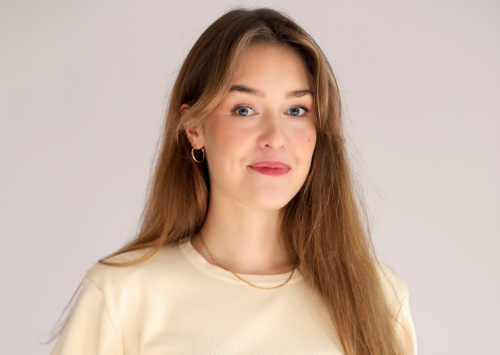
Gabriela Pasek
Director and founder of the school. Qualified teacher of Polish as a foreign language and MA in East Slavic philology. Author of the programme and all teaching materials.
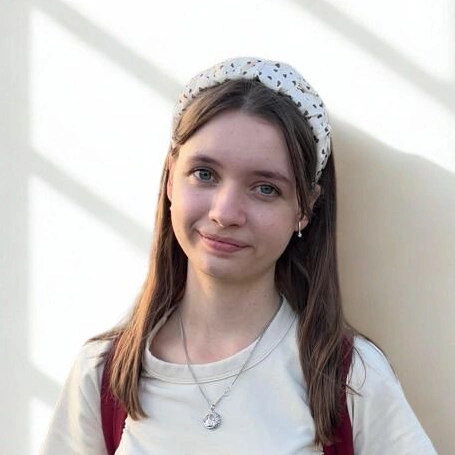
Wiktoria
Prepares students for certificate examinations. Experience interpreting for Polish delegations abroad. Focuses on correct pronunciation.

Julia
Speaks five languages, so she understands the challenges of learning them. Specialist in state examinations and TELC.
What the C1 course includes
Around 90 hours of online lessons — the number matched to how much you actually need to reach operational proficiency.
Lessons on interactive Miro boards
At C1 most of the time goes into comparing variants. On the Miro board you write the same sentence in four registers side by side and analyse which suits which text — something impossible to do on paper.
- Stylistic variants placed side by side
- Access to all materials 24/7, including after the course
- Original press and literary texts for analysis
- Full audio and video connection with your teacher
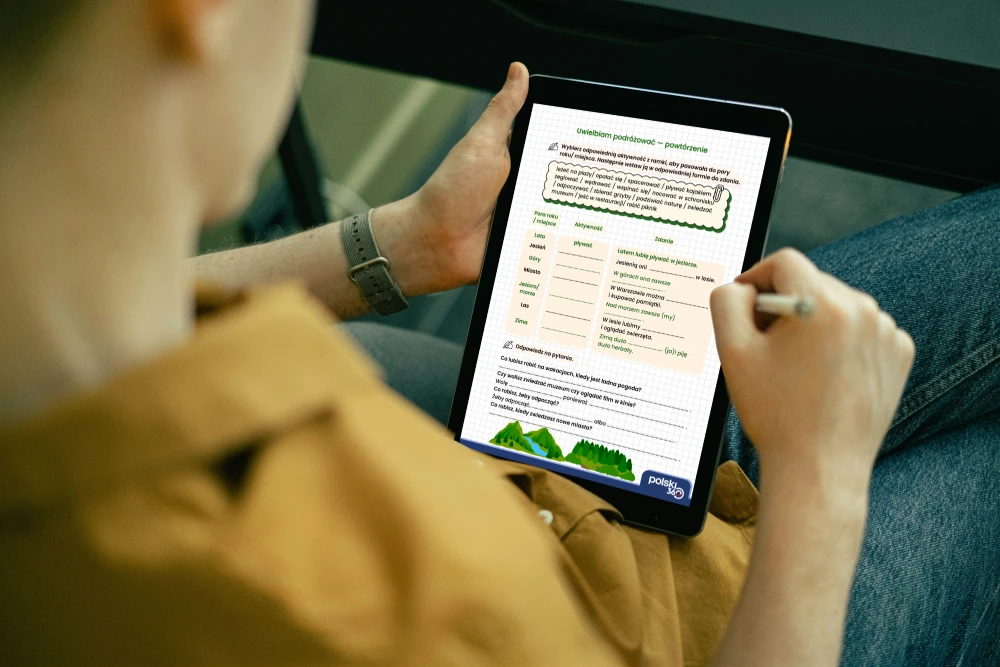
You learn when it suits you
There is no fixed hour you have to fit into. We fit around your week.
Learners at C1 usually work in Polish in positions carrying responsibility, with calendars that are hard to plan a quarter ahead. That is why we agree times as we go.
How long does the C1 course take?
The calculator assumes 90 hours — the guideline figure for someone who has completed our B2 course. We set the real number after the trial lesson.
How many lessons per week?
The course covers 90 teaching hours. The total price is fixed regardless of pace.
What our learners say
“Thank you so much for preparing me for the B1 exam! I recommend the school and I will definitely come back.”
“Five stars. The materials are genuinely useful and Gabriela explains everything clearly. I study together with my son from different places — it works beautifully.”
“A great school, my daughter is making fast progress and really enjoys the lessons. Highly recommended!”
Polish course C1 — what effective operational proficiency means
In the terminology of the regulation, C1 is the „level of effective operational proficiency”. The name captures it: the language stops being a subject of study and becomes a tool you use without thinking. Errors may still occur but must not affect the effectiveness of communication, and your pronunciation may reveal your origin only as information — not as an obstacle. There is also a requirement absent from every lower level: your style must show individual character.
What is added after B2
The regulation expands the list of registers from three to seven — alongside formal, informal and colloquial come the official, academic, journalistic and literary. Devices appear that were not there before: metaphor, rhetorical questions, archaisms and dialect words. The speech is added to the text types, and the oral module brings the interpretation of a maxim or quotation as well as participation in negotiation. In listening, recordings are not only authentic but also played under imperfect acoustic conditions.
Forms that trip up even advanced learners
Three groups come up most often in lessons. Collective numerals — troje skrzypiec, pięcioro dzieci — because English has no equivalent at all. The declension of surnames, foreign ones in particular, along with nominal groups such as pani profesor Ewa Nowak. And finally verbal prefixes: prze- alone has eleven distinct meanings listed in the regulation, from przebiec to przegapić.
How many hours you actually need
We quote 90 hours, but it is a reference point rather than a fixed figure — and we say so plainly, because the differences between learners are greatest at this level. We assume someone who has completed our B2 course and knows exactly that material. If you obtained your B2 certificate elsewhere or several years ago, some topics will need catching up. If you have worked in Polish for years, handle official correspondence and read the press, you may need considerably less. In the free trial lesson we check this specifically and give you a realistic figure before you pay for the first month.
How to start the C1 course
Free trial lesson
We check how much you actually need to reach C1 and give you a specific number of hours.
Choose format and times
You decide: one-to-one or in a pair. We agree times that fit your schedule.
Around 90 hours of lessons
You work on registers, rare forms and your own style.
Registration and exam
We help with the registration paperwork — you walk into the exam prepared.
Common questions about the C1 course
Why do you say „around 90 hours” instead of an exact figure?
Because the differences between learners are greatest at C1. Ninety hours assumes someone who has completed our B2 course and knows exactly that material. If you obtained your B2 certificate elsewhere, some topics may need catching up. If you have worked in Polish for years, you may need less. We give you the real figure after the free trial lesson.
Are lessons held in person?
No. Polski360 is an online-only school — we do not run in-person classes in any city. All lessons take place over the internet, on interactive Miro boards with audio and video. That means you can learn from anywhere in Poland or abroad.
How does C1 differ from B2?
Above all in stylistic range: at B2 you distinguish three registers, at C1 seven — including the official, academic, journalistic and literary. The speech is added as a text type, along with rhetoric in text composition and devices such as metaphor, archaisms and dialect words. Exam recordings play at natural speed and under imperfect acoustic conditions. Your style is also required to show individual character.
How much does the C1 Polish course cost?
One-to-one it is 880 zł per month, so around 9900 zł for the 90-hour course. In a pair it is 720 zł per month per person, around 8100 zł per person. Because the number of hours is set individually, the final figure may differ — the hourly rate stays the same.
Do I need the B2 certificate to start?
You do not need the document, but you do need the level. The course assumes you write an argumentative essay freely and know participles, the passive voice and conditional periods. In the trial lesson we check this specifically and will honestly suggest the B2 course first if the foundations are missing.
Do you help with registering for the exam?
Yes. We advise which examination centre and session to choose and help you complete the registration formalities.
Does the teacher speak English?
Yes. In the early lessons your teacher can explain difficult points in English, so you are never left guessing. As the course progresses that becomes less necessary and lessons shift increasingly into Polish.
Do I have to pay for the whole course upfront?
No. You pay month by month and can stop at any time — we refund the value of any unused lessons. Unlike schools that require payment for an entire semester in advance, you take no financial risk with us.
Are materials included in the price?
Yes. You buy no textbooks separately, and access to the materials on the Miro boards stays with you after the course ends.
Ready for the C1 examination?
Book a free trial lesson — we will check how much you actually need to reach proficiency and give you a specific number of hours.
Book a free trial lesson