A preparation course for the certificate examination in Polish at level B2 — the threshold required for studying in Polish, having a foreign diploma recognised and for parts of several regulated professions.
- 100% online. You learn from anywhere in Poland or abroad.
- Grammatical accuracy is a separate exam module at B2. Being understood is not enough — form is marked on its own.
- Authentic recordings from radio and television, not studio dialogues from a textbook.
- No upfront payment. You pay monthly and can stop at any time.
How much does the B2 Polish course cost?
The same programme in both formats — what differs is the number of people and the hourly rate. At B2, one-to-one leaves the most time for going through your written work.
One-to-one
Online lessons, the teacher’s full attention, and times and pace tailored entirely to you.
- Every essay marked individually — against the criteria used by the examination board
- Lesson times built around your schedule, evenings and weekends included
- Pace from 1 to 4 lessons per week
- Start at any time
Free, with no obligation
In a pair
Online with a partner, friend or family member — you both pay less than for one-to-one lessons.
- Practise discussion and argument with a partner — exactly what the oral module tests
- You agree times together with the teacher
- Ideal for couples who both need the certificate
- Start at any time
Free, with no obligation
No upfront payment for the whole course. You pay month by month and can stop at any time — we refund the value of any unused lessons.
All prices are per participant and include materials.
The fee for the state examination itself is not included in the course price.
See the full price list →
What you will learn on the B2 course
The programme matches the grammar list for level B2 from the ministerial regulation. It covers everything from the lower levels, extended with new forms.
Forms that do not appear at B1Click to expand
- Participles, active and passive (słuchający, zmęczony)
- Adverbial participles — simultaneous (słuchając) and anterior (wysłuchawszy)
- Passive voice (Pokój zostanie uporządkowany.)
- Impersonal forms in -no, -to (jedzono, otwarto)
- Impersonal forms with „się”
- Declension of cardinal, ordinal and indefinite numerals
- Indefinite and universal pronouns
- Irregular verbs: wieźć, znaleźć, siąść, piec, móc, biec
- Difficult nouns: pieniądz, przyjaciel, ramię, oko
Syntax and complex sentencesClick to expand
- Coordinate and subordinate clauses — the full set of conjunctions
- Multi-clause complex sentences
- Conditional periods: real, possible and unreal
- Direct and reported speech and converting between them
- Relative pronouns
- Expanding and reducing simple sentences
- Syntactic synonymy — several ways of expressing the same content
- Functions of every case in extended constructions
Word formation and styleClick to expand
- Verbal nouns (pisać – pisanie)
- Agent nouns and feminine forms (lekarz – lekarka)
- Place nouns from verbs (pływać – pływalnia)
- Adjectives from nouns and prepositional phrases
- Three registers: formal, informal and colloquial
- Stylistic devices: synonyms, antonyms, epithets, comparisons
- Diminutives and terms of endearment
- Composition and cohesion in a longer text
Written text typesClick to expand
- Argumentative essay
- Reflective essay — presenting your own views
- Review and report
- Character description of a person and a milieu
- CV and cover letter
- Formal application and official letter
- Letter and email — formal and informal variants
- Describing a person, place and situation
- Narrative, autobiography, advertisement
- Spelling and punctuation: ó/u, rz/ż, h/ch
Speaking and listeningClick to expand
- Taking part in a discussion, including formal settings
- Presenting a position and arguing convincingly
- Summarising and commenting on a film, book or article
- A short talk followed by questions
- Repair strategies: paraphrase, describing unknown words
- Authentic recordings: interviews, commentary, reportage
- Understanding functional, journalistic and literary texts
- Idiom and conversational conventions
Your teachers
At B2 what matters most is the quality of feedback — whether someone can show you why a grammatically correct sentence still sounds wrong.
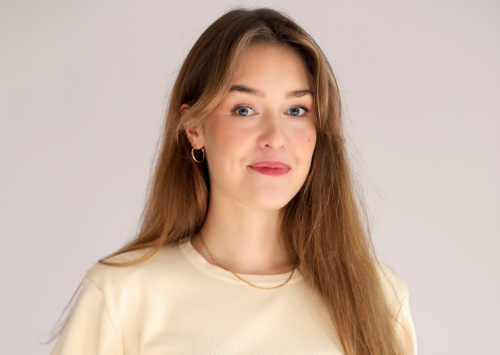
Gabriela Pasek
Director and founder of the school. Qualified teacher of Polish as a foreign language and MA in East Slavic philology. Author of the programme and all teaching materials.
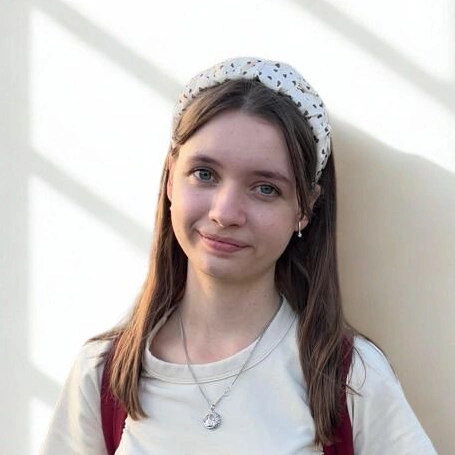
Wiktoria
Prepares students for certificate examinations. Experience interpreting for Polish delegations abroad. Focuses on correct pronunciation.

Julia
Speaks five languages, so she understands the challenges of learning them. Specialist in state examinations and TELC.
What the B2 course includes
70 hours of online lessons — from tidying up your grammar to writing an argumentative essay unaided and holding your own in a discussion.
Lessons on interactive Miro boards
At B2 most of the work is editing text. On the Miro board your essay is annotated live: the teacher marks passages, offers syntactic alternatives and shows how the same thought sounds in a formal and a colloquial register.
- Written work corrected together, sentence by sentence
- Access to all materials 24/7, including after the course
- Real past exam papers to practise on
- Full audio and video connection with your teacher
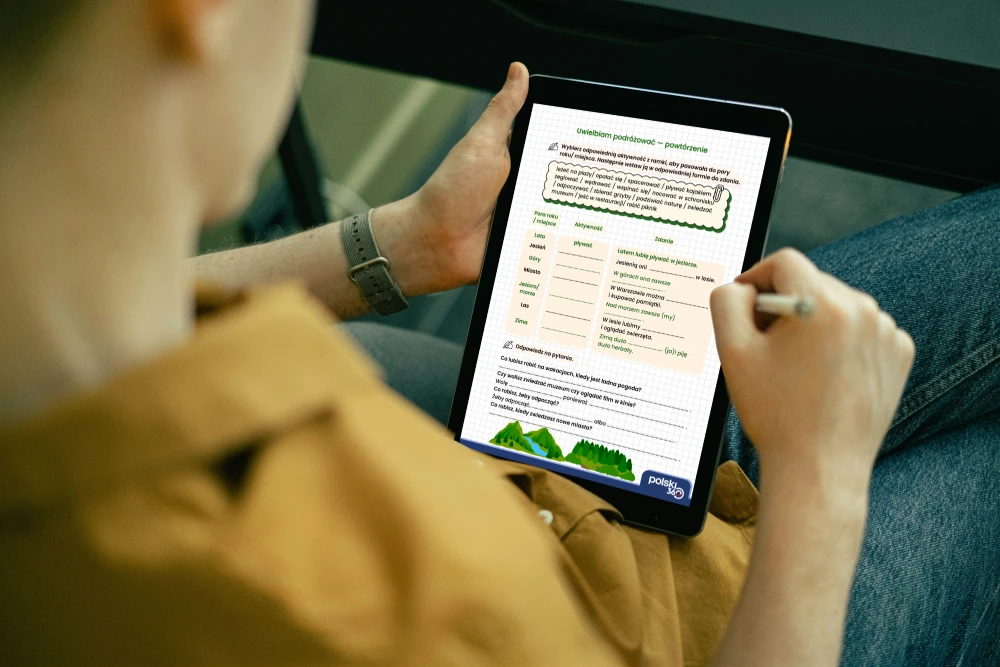
You learn when it suits you
There is no fixed hour you have to fit into. We fit around your week.
At B2 most learners already use Polish professionally — often alongside travel and shifting commitments. That is why we agree times as we go rather than once for the whole course.
How long does the B2 course take?
If you are aiming for a particular exam session, count backwards from its date.
How many lessons per week?
The course covers 70 teaching hours. The total price is fixed regardless of pace.
What our learners say
“Thank you so much for preparing me for the B1 exam! I recommend the school and I will definitely come back.”
“Five stars. The materials are genuinely useful and Gabriela explains everything clearly. I study together with my son from different places — it works beautifully.”
“A great school, my daughter is making fast progress and really enjoys the lessons. Highly recommended!”
Polish course B2 — what the jump from B1 actually involves
Between B1 and B2 the issue is not a bigger vocabulary but a change in what is expected of you. At B1 it is enough to be understood. At B2 you are assessed on how you say and write it: whether you can express the same content in several ways, match the register to the situation and build an argument rather than a description. Grammatical accuracy forms a separate exam module at this level.
Forms that only appear at B2
Three groups cause the most difficulty. First, participles and adverbial participles — English has something comparable in „-ing” and „-ed” clauses, which helps, but Polish forms carry aspect as well. Second, the passive voice and impersonal forms in -no and -to; English speakers have a useful anchor here in the impersonal „one” and in passive constructions without an agent. Third, unreal conditional periods. All three are named in the regulation and appear regularly in the grammar module.
The essay — where most points are lost
B2 adds an argumentative text that did not exist at lower levels. Describing a phenomenon is not enough: you have to state a thesis, support it, anticipate a counter-argument and close with a conclusion. Examiners assess content, structure, range of language and accuracy separately, so a well-written but poorly organised text still loses marks.
What the B2 certificate is needed for
B2 is the level required for degree programmes taught in Polish, for having a diploma obtained abroad recognised, and in parts of the procedures for regulated professions. Employers increasingly expect it for roles involving client contact or documentation. The previous stage is the B1 course; the next one is the C1 course.
How to start the B2 course
Free trial lesson
We check your level and which exam modules need the most work.
Choose format and times
You decide: one-to-one or in a pair. We agree times that fit your schedule.
70 hours of lessons
You work through every exam module with the same teacher, writing regularly throughout.
Registration and exam
We help with the registration paperwork — you walk into the exam prepared.
Common questions about the B2 course
Are lessons held in person?
No. Polski360 is an online-only school — we do not run in-person classes in any city. All lessons take place over the internet, on interactive Miro boards with audio and video. That means you can learn from anywhere in Poland or abroad.
How does the B2 exam differ from B1?
In three ways. Grammatical accuracy is a separately marked module. The listening recordings are authentic — taken from radio and television at natural speed. And text types requiring argument appear: the argumentative and reflective essay, alongside official documents, a CV and a cover letter.
I have the B1 certificate — how far is B2?
The course covers 70 hours and at two lessons a week takes about eight months. That is realistic for someone with a solid B1 who uses Polish regularly. If you passed B1 several years ago and have written little Polish since, we will say honestly in the trial lesson whether a refresher makes sense first.
How much does the B2 Polish course cost?
One-to-one it is 880 zł per month, which is 7700 zł for the full 70-hour course. In a pair it is 720 zł per month per person, so 6300 zł per person. The fee for the state examination itself is not included.
Do you correct my written work?
Yes, and it is the core of this course. Every essay, report and official letter is discussed against the criteria used by the examination board: content, structure, range of language and accuracy assessed separately.
Do you help with registering for the exam?
Yes. We advise which examination centre and session to choose and help you complete the registration formalities.
Does the teacher speak English?
Yes. In the early lessons your teacher can explain difficult points in English, so you are never left guessing. As the course progresses that becomes less necessary and lessons shift increasingly into Polish.
Do I have to pay for the whole course upfront?
No. You pay month by month and can stop at any time — we refund the value of any unused lessons. Unlike schools that require payment for an entire semester in advance, you take no financial risk with us.
Are materials included in the price?
Yes. You buy no textbooks separately, and access to the materials on the Miro boards stays with you after the course ends.
Ready for the B2 examination?
Book a free trial lesson — we will check your level, show you which modules need the most work and map out a 70-hour plan.
Book a free trial lesson